Entry, Descent, and Landing (EDL) is the process of guiding a spacecraft entering a planet’s atmosphere, decelerating from orbit, and descending to a safe landing site on the planet’s surface. Atmospheric disturbances, localization error, and other factors contribute to substantial deviations from the nominal descent trajectory that must be accounted for when selecting a landing target. This work focuses on the Powered Descent (PD) phase, during which the spacecraft uses chemical rocket engines to simultaneously steer and decelerate to a target touchdown point. NASA Technology Area (TA) 9.2.6 (Large Divert Guidance) identifies a guarantee on satisfaction of constraints, optimal or near-optimal fuel consumption, and on-board computational feasibility as necessary components of a next generation solution. In this research we are concerned with applying techniques from stochastic optimal control theory to the problem of powered descent guidance with the objective of improving fuel performance.
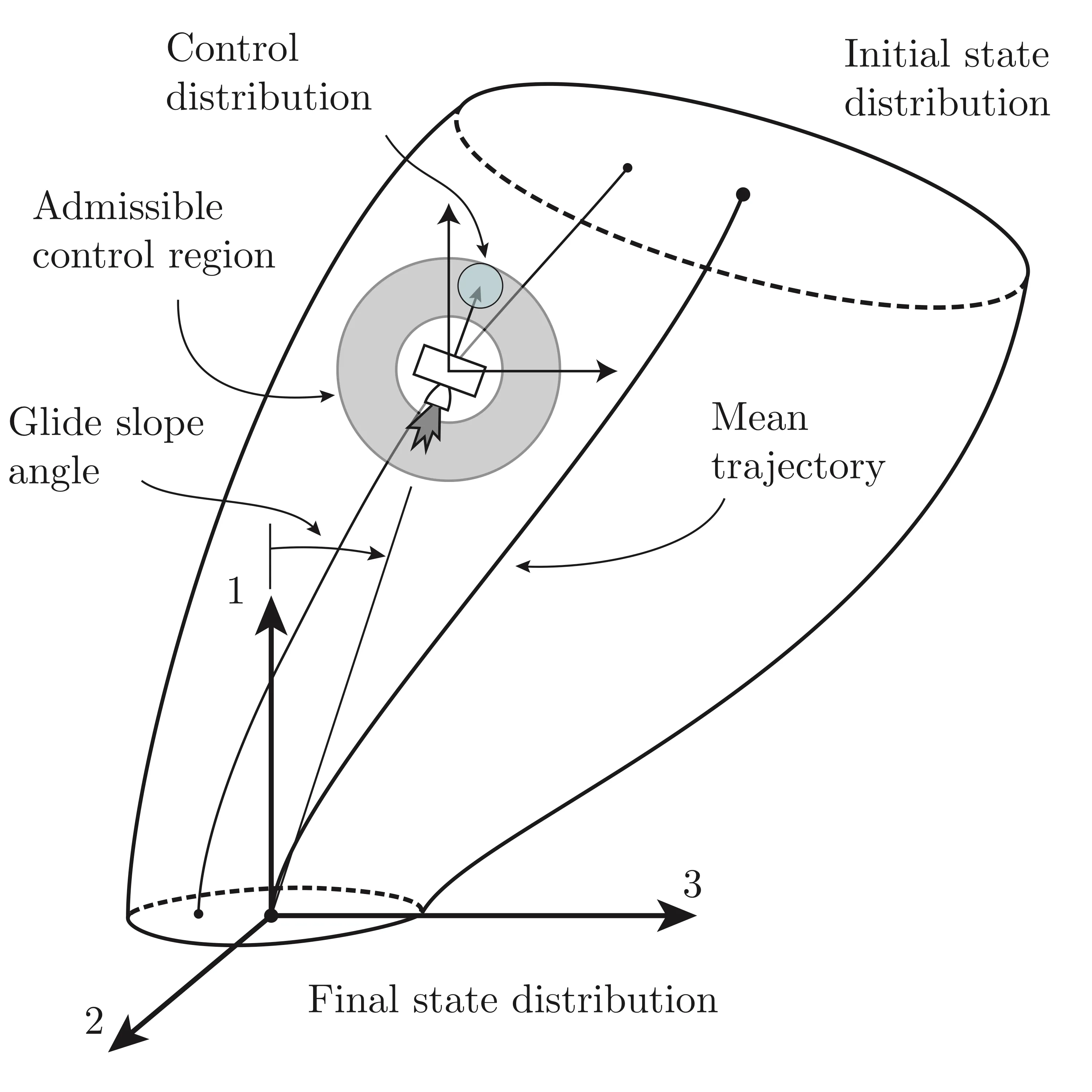
In powered descent guidance (PDG), the spacecraft position and velocity are random variables subject to random external forces, as shown graphically below.
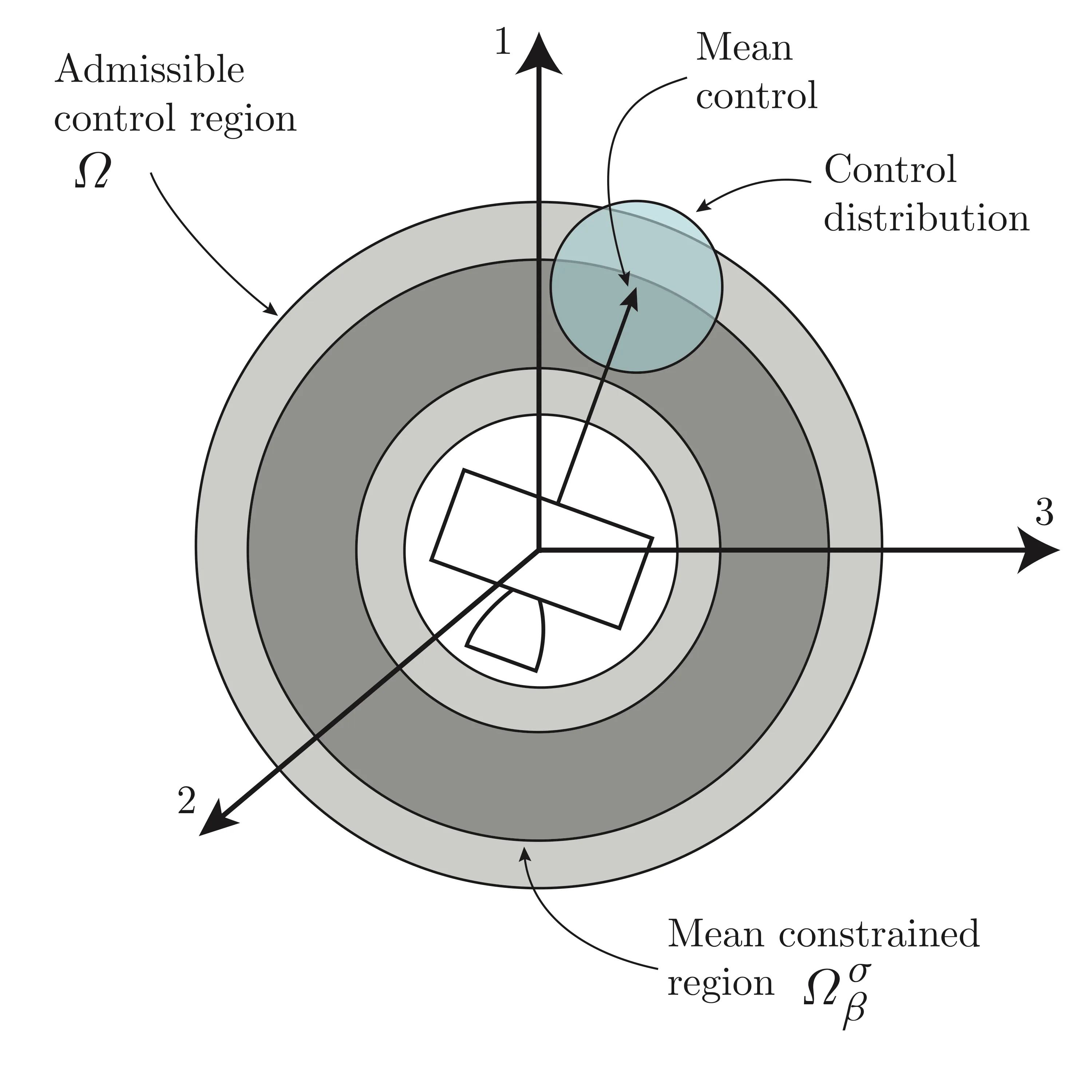
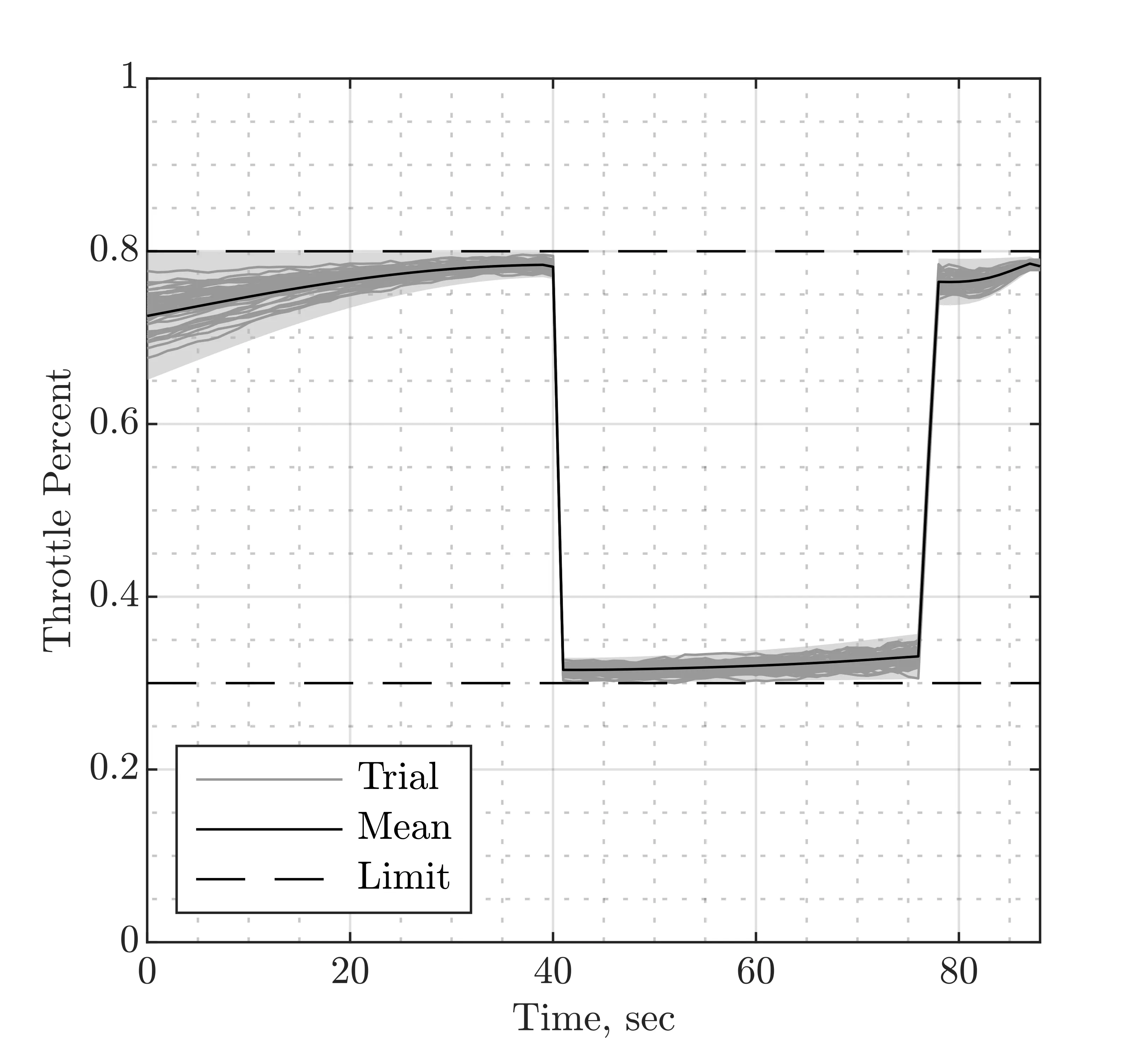
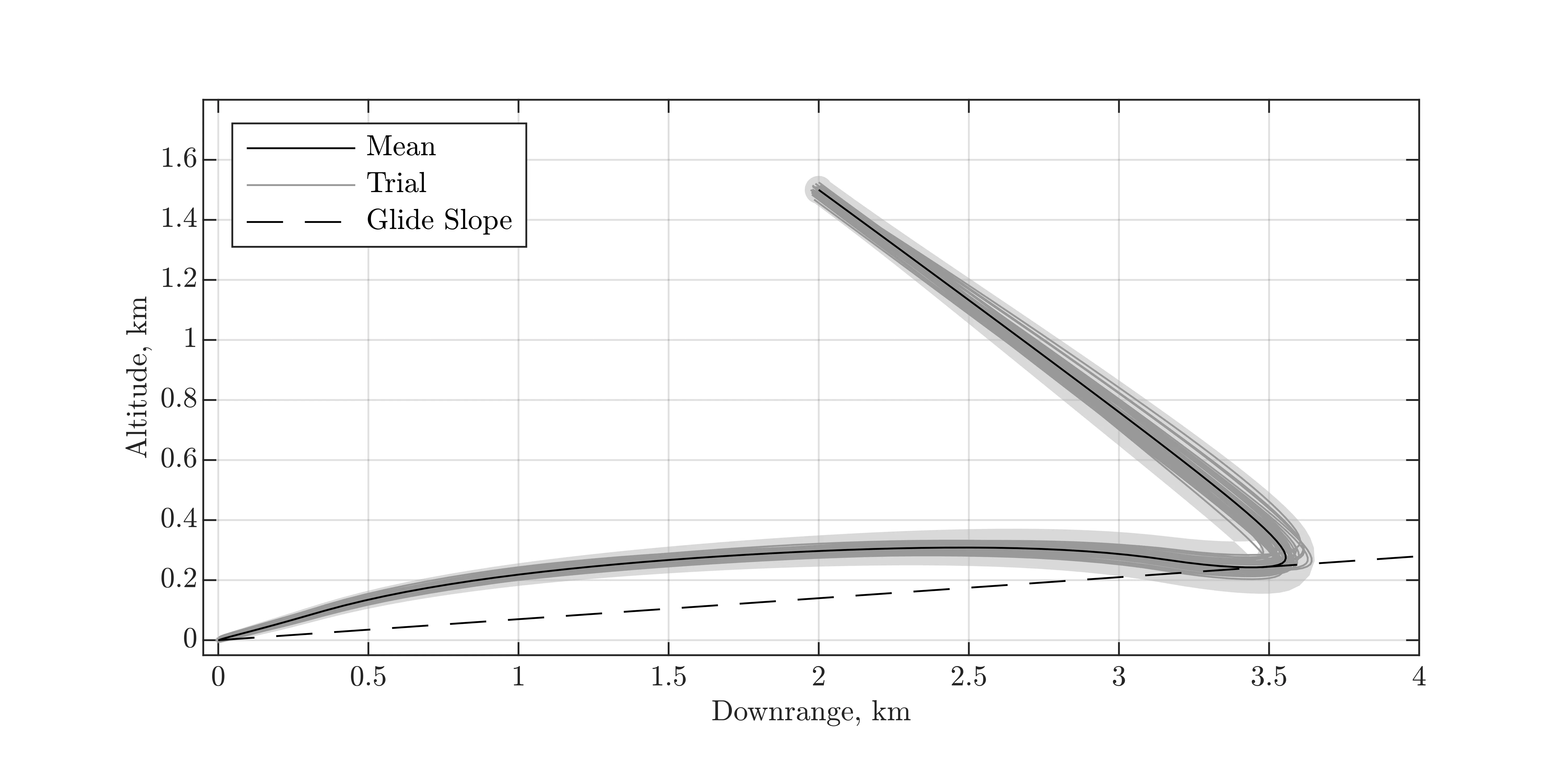
Along a minimum-fuel descent trajectory the nominal throttle command sits at either its upper or its lower limit for almost the entire maneuver, which leaves no authority for the feedback corrections that disturbances demand. Modeling the descent as a stochastic process makes the necessary margin computable rather than heuristic: the allowance carried on the nominal throttle is derived from the covariance of the closed-loop thrust commands, so that a nominal command respecting the margin guarantees that the closed-loop command respects the true throttle limits with a prescribed probability. The corrections themselves are the minimum-variance solution subject to a bound on the terminal state covariance, which couples the two halves of the problem: a tighter landing ellipse demands more feedback authority, and that demand feeds back into the margin the nominal trajectory must carry. Full details are given in our paper. The example below was solved with the requirement that the thrust not saturate with 90% probability, and the trajectory covariance is steered to its terminal value while the closed-loop throttle remains within the allowable limits.
The same stochastic framing carried into two further guidance problems and into the underlying theory. For atmospheric entry, altitude-dependent density variation was modeled as a stochastic differential equation in the spirit of the GRAM density models, yielding a closed-form linear covariance model for entry and, from it, a closed-loop guidance law of the same shape as the Apollo final-phase algorithm flown on Mars Science Laboratory and Mars 2020, namely a reference trajectory, a linear feedback law and a table lookup, but with gains designed to steer the trajectory covariance rather than to track a single path. In a Monte Carlo study of a Mars entry scenario this approximately halved the range-to-go error at the final time while holding altitude and velocity errors constant. For aerocapture, where the disturbance is spatial rather than temporal, the atmosphere was modeled as a Gaussian random field and reduced along the nominal trajectory to a sequence of jointly Gaussian vectors, which brings the problem within reach of successive convex programming; the resulting affine feedback law minimizes the 99th percentile of the Δv required to reach the target periapsis and apoapsis rather than its mean value.
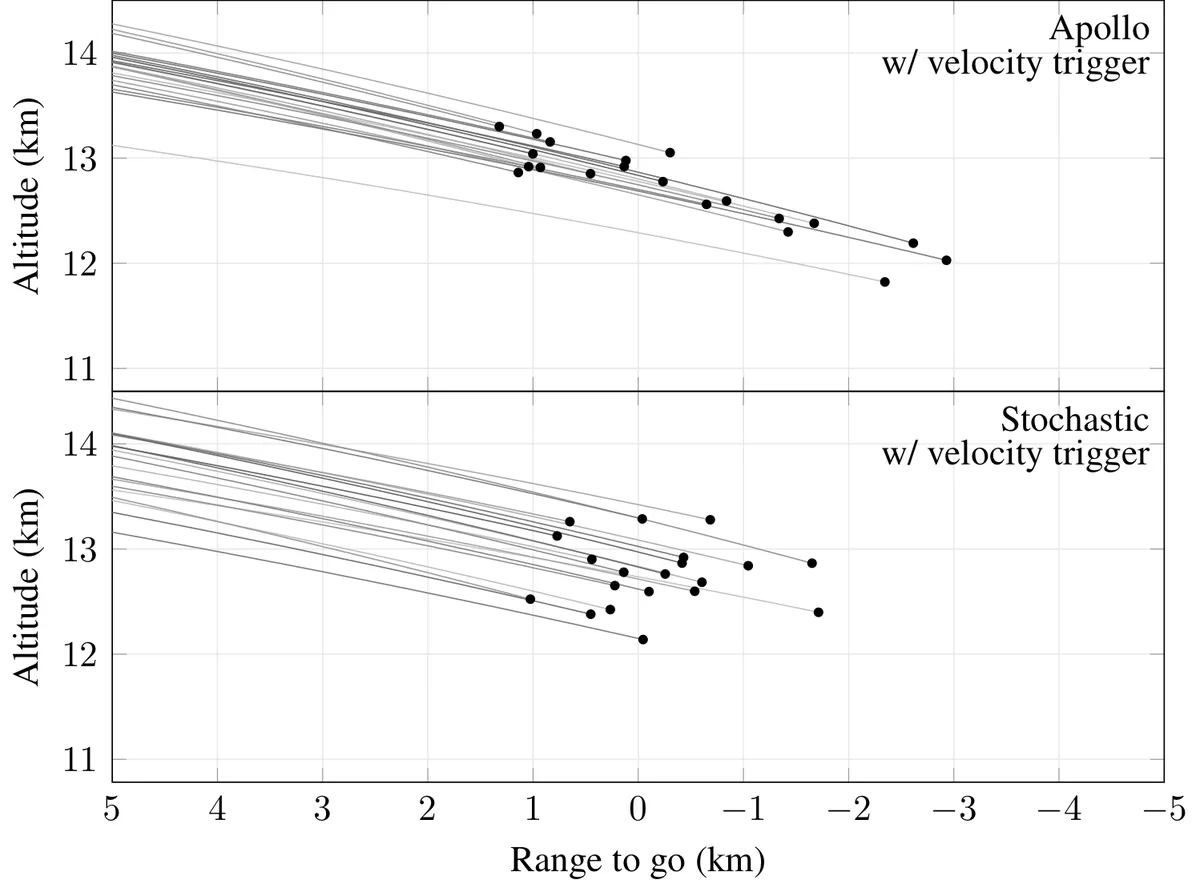 Range-to-go dispersions for a Mars entry scenario: the Apollo final-phase algorithm (top) against the proposed stochastic entry guidance (bottom).
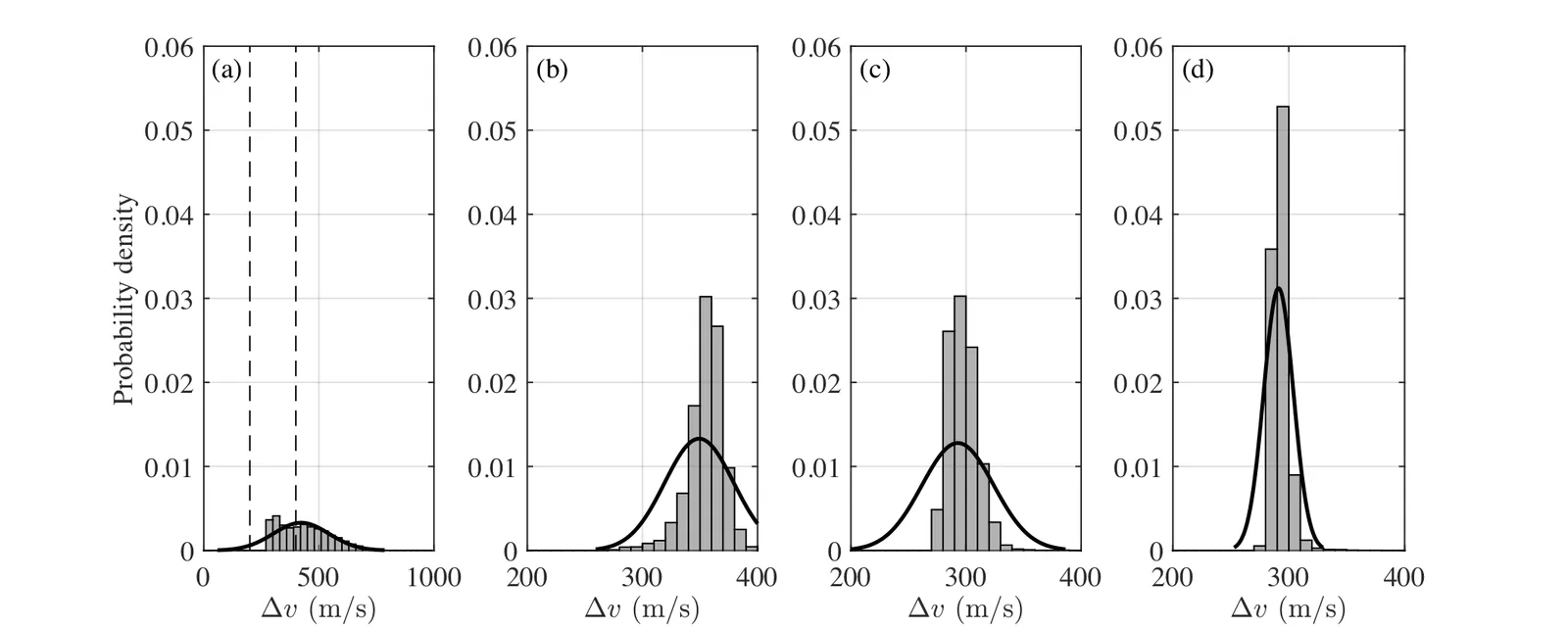 Distribution of the Δv required for aerocapture over four iterations, from the open-loop guess (a) to the converged feedback law (d). The controller shifts the mean and tightens the spread so that the 99th percentile is minimized.
Underpinning these applications, the general theory of chance-constrained covariance steering was extended in three directions: a convex formulation of the maximum Euclidean magnitude chance constraint, an output-feedback formulation in which, unlike classical LQG control, the optimal feedback depends on both the process noise and the observation model, and nonlinear continuous-time covariance steering solved by successive convexification. The last of these was demonstrated on a low-thrust Earth-to-Mars transfer, where optimizing the feedback jointly with the nominal control lets the nominal thrust be balanced against the margin the feedback needs.
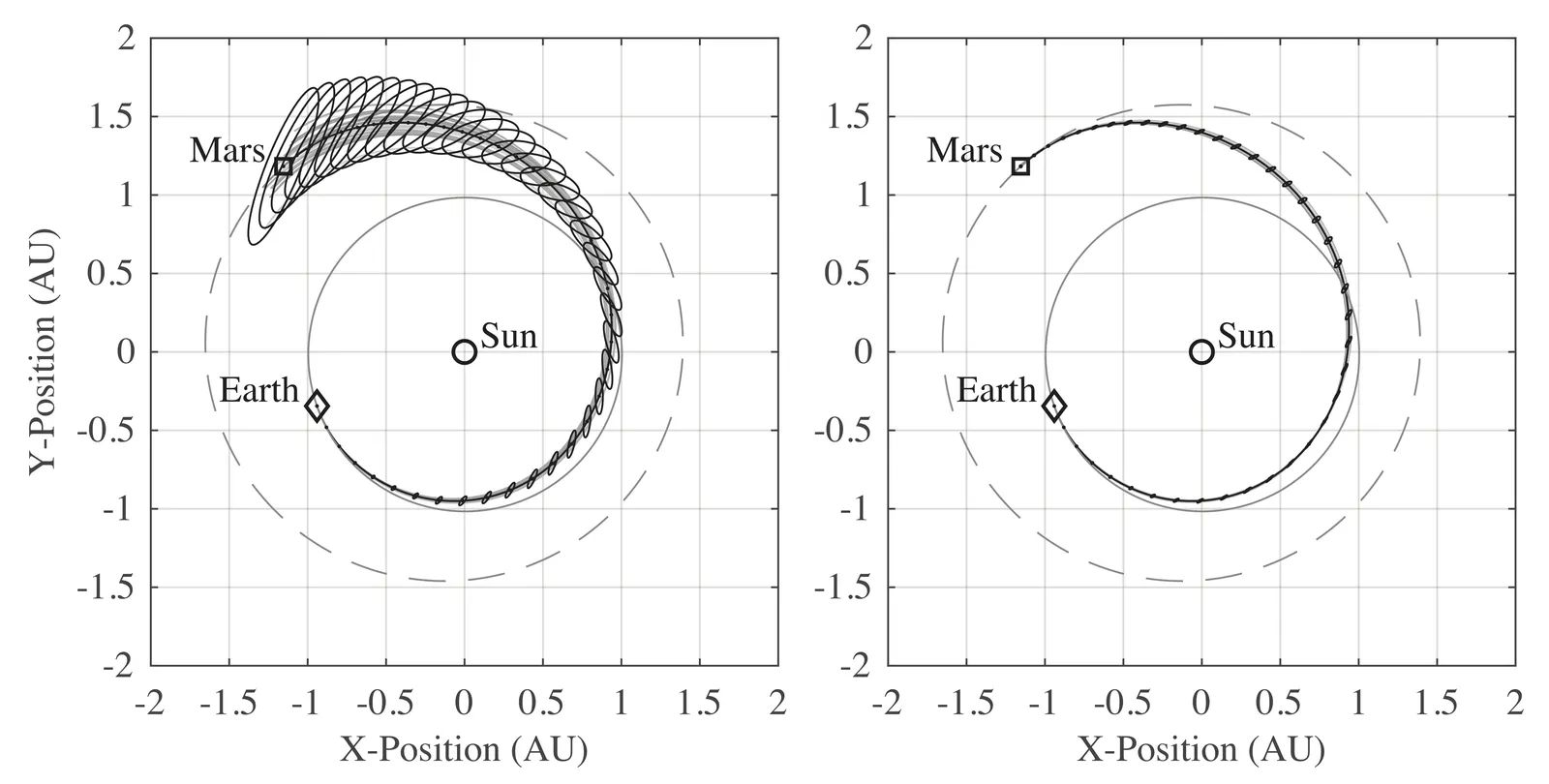 A low-thrust Earth-to-Mars transfer without feedback (left) and with the covariance steered by the optimized feedback law (right).
Sponsors
This project is supported by NASA Space Technology Research Fellowship.
Selected Publications and Presentations
Ridderhof, J., Pilipovsky, J., and Tsiotras, P., “Chance-Constrained Covariance Control for Low-Thrust Minimum-Fuel Trajectory Optimization,” AIAA/AAS Astrodynamics Specialists Conference, South Lake Tahoe, CA, August 9-13, 2020.