Sustained operations in space depend on a logistics capability that does not yet exist: the ability to route, service, refuel and resupply assets on orbit as a coordinated chain rather than as a sequence of bespoke missions. ATLAS conducts basic and applied research toward new capabilities in space logistics and mobility, across logistics modeling, space robotics and spacecraft health management.
The work is organized as three synergistic research thrusts. The first is network-based modeling of the space logistics chain, integrating vehicle routing with the full supply chain of fuel, spares, tools and materials, and coupling both to nontraditional orbital design. The second is hybrid soft-rigid robotics for autonomous servicing, combining the accuracy and speed of a rigid arm with the adaptability and dexterity of a soft one, so that servicing is safe and robust against what the manipulator meets. The third is intelligent health monitoring and remaining-life assessment for thrusters, using artificial intelligence together with new sensing to estimate the remaining lifetime of chemical and electric propulsion systems.
Taken together these would change what is operationally possible. The logistics chain model can act as a command-and-control decision support suite, coordinating the whole chain in real time and dispatching one or more servicers from strategically placed depots carrying the fuel and resources a given servicing operation needs. The high-degree-of-freedom manipulators make that servicing robust and safe for both known and unknown objects. The health management technologies track the state of a spacecraft’s thrusters across repeated refuelings and services and, where applicable, determine the next servicing demand to feed back into the chain.
Our own contribution is the second thrust. Robust and safe robotics for autonomous space services is addressed here through a hybrid soft-rigid concept, the Variable Length Nested Soft (VaLeNS) configuration, which combines the accuracy and speed of a rigid arm with the adaptability and dexterity of a soft one. The work covers both the design of the concept itself and the perception, estimation, planning and control algorithms that go with it, with the aim of minimally invasive servicing of a diverse set of spacecraft — including ones that are highly uncertain or uncooperative.
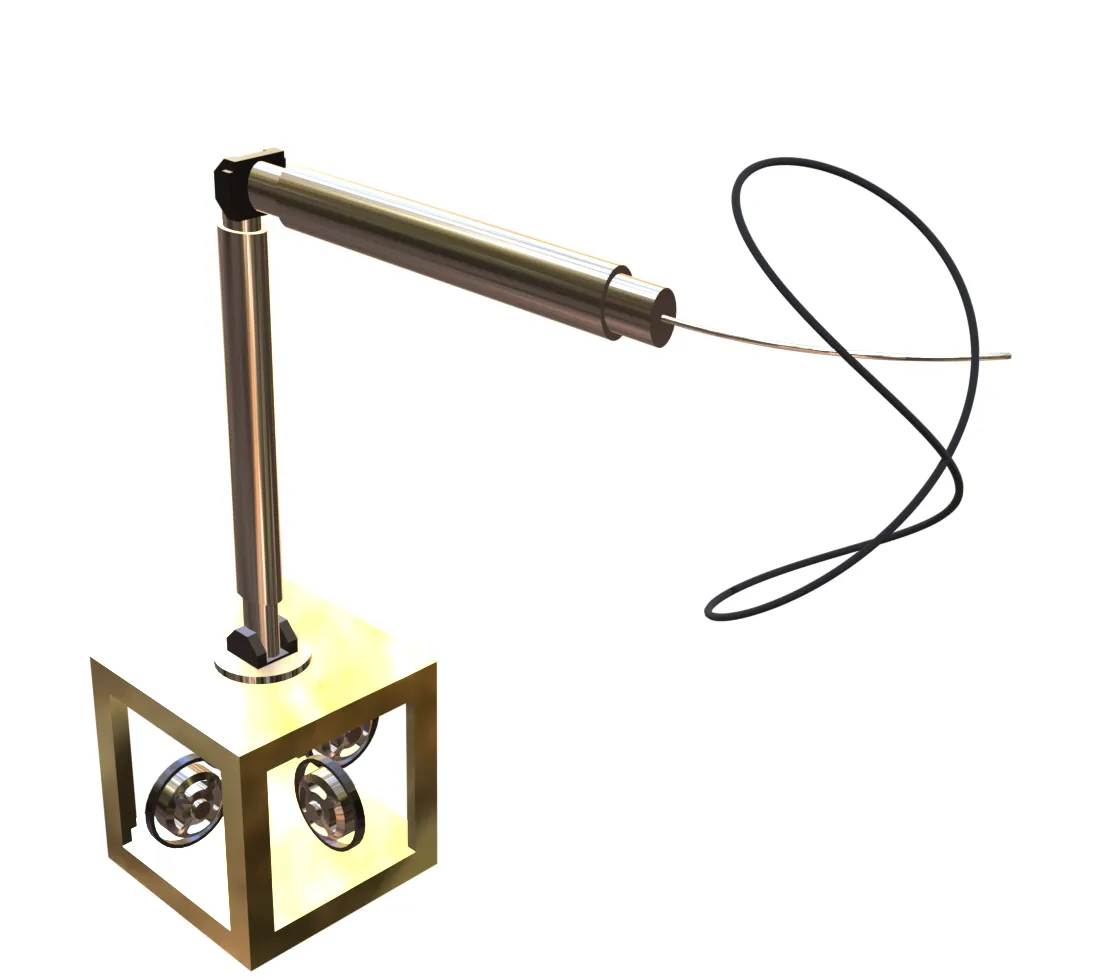 The Variable Length Nested Soft (VaLeNS) concept: a continuum section nested inside a rigid link, so that the arm can be extended and stiffened as the task demands, carried on a spacecraft whose own attitude responds to every motion it makes.
This project is in collaboration with Koki Ho and Patricio Vela at Georgia Tech, and Girish Krishnan at the University of Illinois Urbana-Champaign.
Sponsors
This project is sponsored by AFOSR and AFRL.
Selected Publications and Presentations
Ticozzi, L., and Tsiotras, P., “Factor Graph-Based Active SLAM for Spacecraft Proximity Operations,” AAS/AIAA Astrodynamics Specialist Conference, Broomfield, CO, Aug. 11-15, 2024.
Velentzas, I. G., Dor, M., and Tsiotras, P., “Line-Based Monocular SLAM for Spacecraft RPO,” 4th Space Imaging Workshop, Atlanta, GA, Oct. 7-9, 2024.
Prakash, A., and Tsiotras, P., “Multi-Contact Force Estimation for Continuum Robots via Gaussian-Parameterized Factor Graphs,” 2026.
Ticozzi, L., Vela, P. A., and Tsiotras, P., “Factor Graph-Based Shape Estimation for Continuum Robots via Magnus Expansion,” 2026.