This project developed a unified dual-quaternion framework for the kinematics, dynamics, and control of spacecraft-mounted robotic manipulators. Dual quaternions give a compact, singularity-free description of pose that admits simple, provably stable pose-tracking control laws; extending the formalism from rigid-body spacecraft to articulated systems provides a single algebraic language for the coupled base–manipulator problem. The resulting dynamics framework generalizes to spacecraft of rooted-tree topology with an arbitrary number of arms and five joint types: revolute, prismatic, spherical, cylindrical, and Cartesian.
The motivating application is on-orbit servicing, where servicer capability must be traded against system complexity. Basic module-exchange servicers keep the servicing spacecraft simple, but displace that complexity onto the host satellite, which must then carry purpose-built electrical and mechanical interfaces. A more dexterous servicer — one that exchanges end-effector tools on orbit — lets host satellites remain closer to flight-proven heritage architectures. That dexterity comes at the price of strong dynamic coupling between the arm and the satellite base, which must be modeled accurately for a servicing mission to succeed.
Two control strategies were demonstrated on this model. The first applied Differential Dynamic Programming to end-effector control, minimizing control effort at the satellite base. The second used coordinated control: prescribed end-effector reference motions are passed to an inverse-kinematics solver that returns joint-angle trajectories, while the recursive Newton–Euler algorithm computes the reaction forces and torques the arm exerts on the base. These are compensated in feedforward by thrusters and control moment gyroscopes. This work was carried out partially in collaboration with Dr. Andrea Antonello, of the University of Padua, Italy.
More recent work has pushed the framework in two directions. We have developed a hybrid dual quaternion feedback law that drives the end effector and the spacecraft base to their desired poses simultaneously, with global asymptotic stability. Because it switches on a hysteresis rather than acting continuously, the law avoids the unwinding that continuous dual quaternion controllers exhibit and resists the chattering that noisy feedback would otherwise induce, while an accompanying allocation scheme keeps the commanded actuator effort bounded near kinematic singularities. Most recent work has replaced the distal portion of the rigid arm with a tendon-driven continuum section. A geometric variable strain parameterization yields a closed-form, minimum-order dynamic model of the resulting hybrid soft-rigid manipulator, derived through the principle of virtual work and with thrusters and variable-speed control moment gyros actuating the base; two inverse-dynamics controllers follow from it, one bringing the system to rest from a non-zero momentum state and one tracking a three-dimensional trajectory in the end-effector task space. The soft section buys dexterity that a purely rigid design cannot match, at the cost of a considerably richer configuration space to model and control.
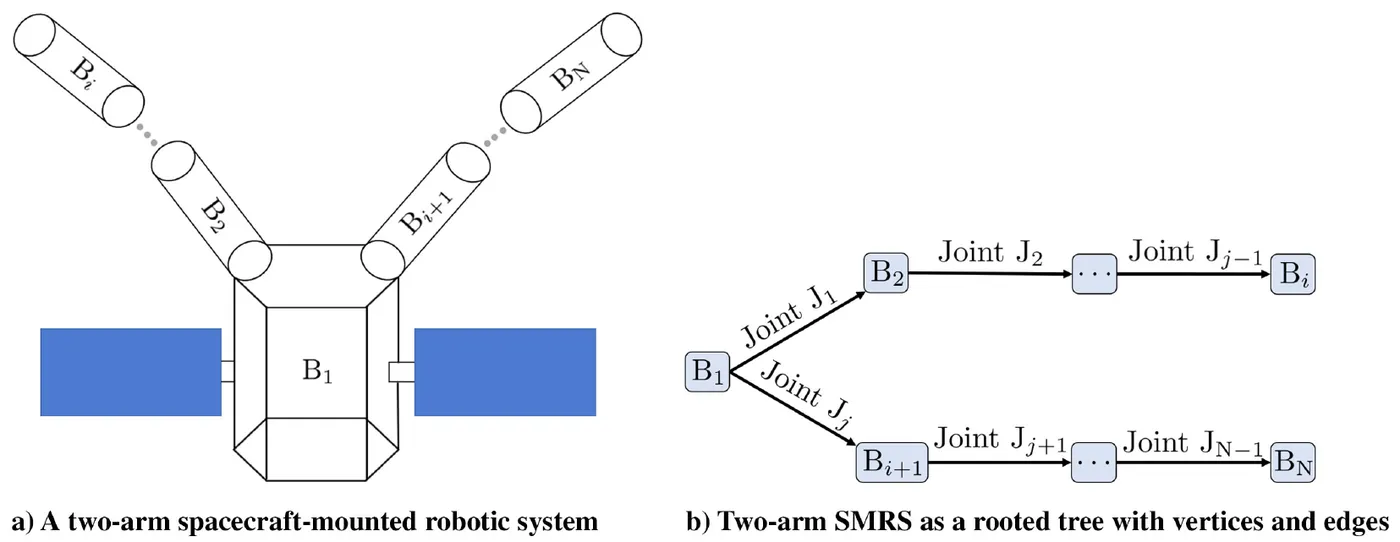 The multibody structure the dual quaternion formulation exploits: bodies as vertices, joints as edges, rooted at the spacecraft base.
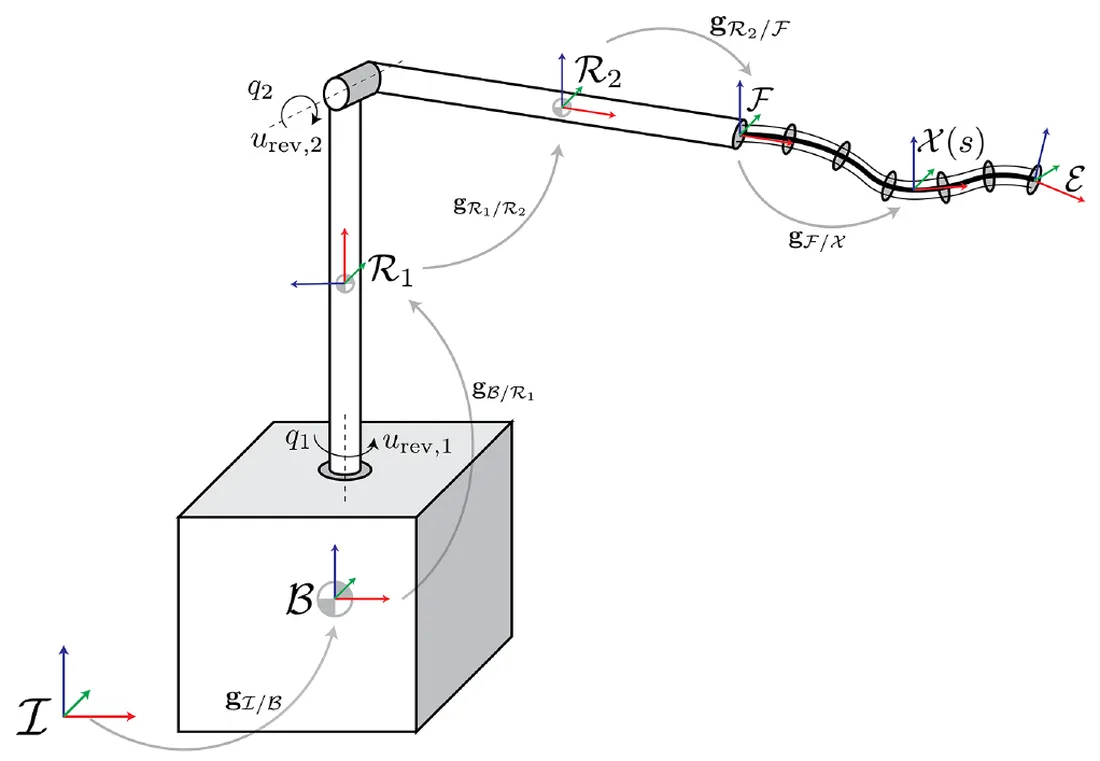 The hybrid soft-rigid manipulator, with the continuum section described by a strain field along its arc length rather than by joint angles.
Sponsors
This research was supported by NSF, JPL, the Aerospace Corporation and AFOSR.
Selected Publications and Presentations
Antonello, A., Valverde, A., and Tsiotras, P., “Free-flying Spacecraft-mounted Manipulators: A Tool for Simulating Dynamics and Control,” AIAA Guidance, Navigation, and Control Conference, San Diego, CA, Jan. 7–11, 2019.
King-Smith, M., Dor, M., Valverde, A., and Tsiotras, P., “Nonlinear Dual Quaternion Control of Spacecraft-Manipulator Systems,” International Symposium on Artificial Intelligence, Robotics and Automation in Space (i-SAIRAS), Pasadena, CA, Oct. 18-21, 2020.
Ticozzi, L., Corinaldesi, G., Massari, M., Cavenago, F., King-Smith, M., and Tsiotras, P., “Coordinated Control of Spacecraft-Manipulator with Singularity Avoidance using Dual Quaternions,” 72nd International Astronautical Congress, Dubai, United Arab Emirates, Oct. 25-29, 2021, Paper IAC-21-D1.6.1.