Deep learning has transformed a great many terrestrial applications, autonomous driving and humanoid robotics among them, but the same advances have not yet been realized on space-borne platforms. This project aims to close that gap, and to put learning-enabled components, deep neural networks included, on board a spacecraft at a level of trust that future missions can rely on. The work is carried out in close collaboration with the Space Vehicles Directorate of the Air Force Research Laboratory.
The obstacle in the way of that vision is certification: there is at present no satisfactory way to certify a learning-enabled component operating in the loop. The paradigm shift this project proposes is to stop treating a deep network as a black box to be validated empirically and to formulate it instead as a dynamical system that shapes distributions of data. Training then becomes a feedback control design problem, which opens it to optimal and robust control theory. Those tools let us study the fundamental structural properties of a learning-enabled component — monotonicity, Lipschitz continuity, passivity and the like — or impose such structure during training, and through them address uncertainty propagation, non-convexity and the effect of noise inside the network, along with stability, expressiveness and robustness.
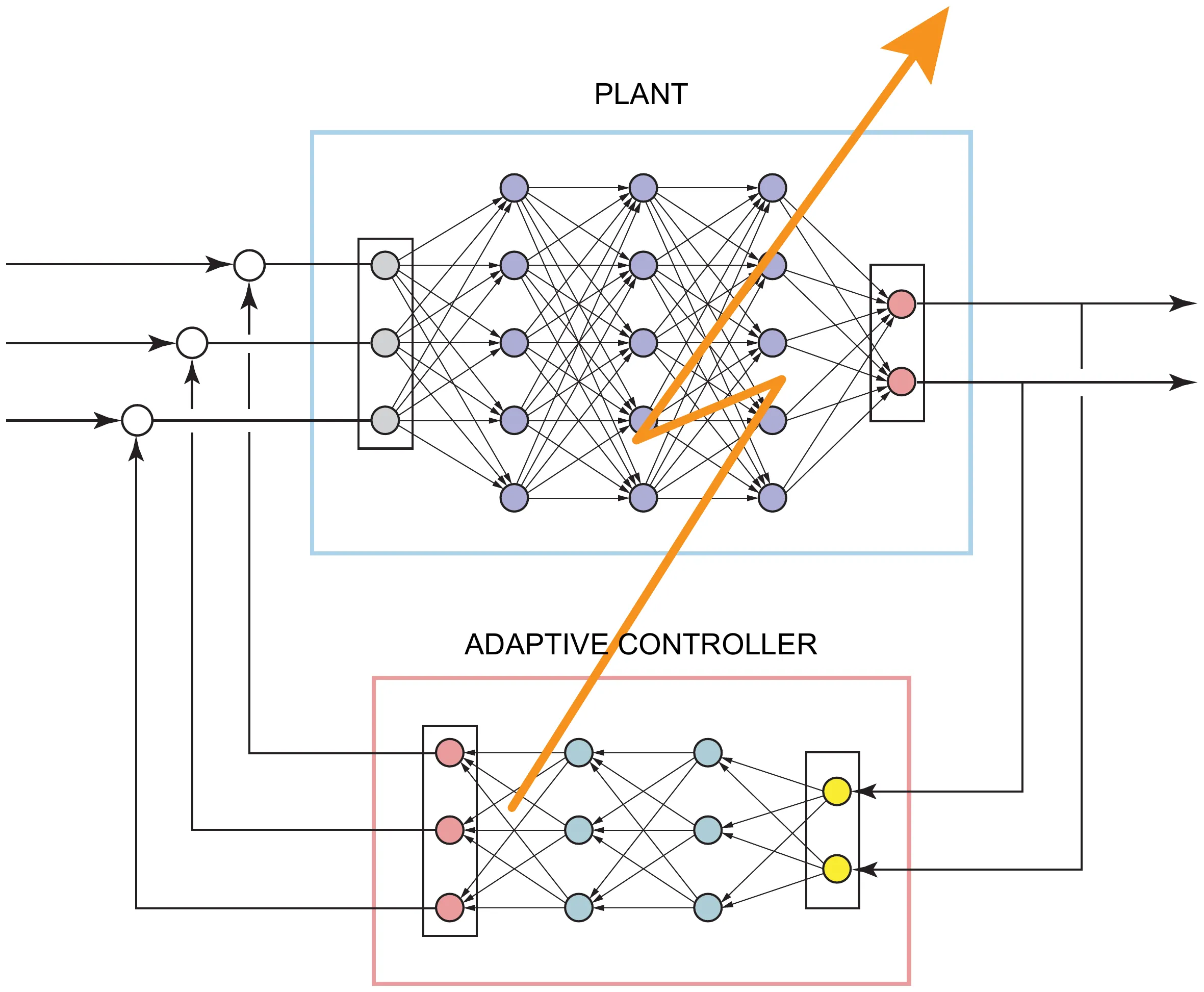 Training read as feedback design: the deep network is the plant, a second network is the adaptive controller, and the two are closed into a loop that control theory can analyze.
The approach has three ingredients. The first propagates distributions through a neural network using characteristic functions, branch-and-bound optimization and scenario-based optimization, which together make probabilistic verification of ReLU networks possible. The second develops principled ways of designing networks that carry robustness guarantees against disturbance inputs, giving faster and more reliable training while safety constraints are satisfied. The third designs globally optimal controllers within a convex model class using ideas from Clifford algebra, yielding controllers that are computationally tractable and carry probabilistic safety guarantees. The resulting framework can be used to train a network or to fine-tune a pre-trained one so that it satisfies safety constraints, and also to arrive at new network architectures.
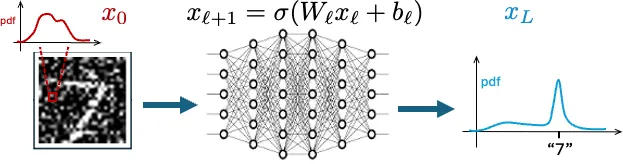 What the network does to a distribution: a broad density over noisy inputs is propagated layer by layer and emerges concentrated on a single label. Verification means bounding that output density rather than sampling it.
We propose to validate the theoretical developments of the previous tasks by following a rigorous evaluation plan of increasing complexity and realism, starting from high-fidelity simulations in a synthetic environment, followed by hardware experiments on scaled, controlled versions of a space inspection problem using the ASTROS and COSMOS air-bearing platforms at Georgia Tech, and finally moving on to experimental validation on a larger platform at our partner facilities at the Space Vehicles Directorate of the Air Force Research Laboratory (AFRL) in Albuquerque, NM. Although the work is motivated by, and bears directly on, spacecraft applications, the theory and the mathematical techniques apply to any cyber-physical system with a deep network at the core of its learning mechanism.
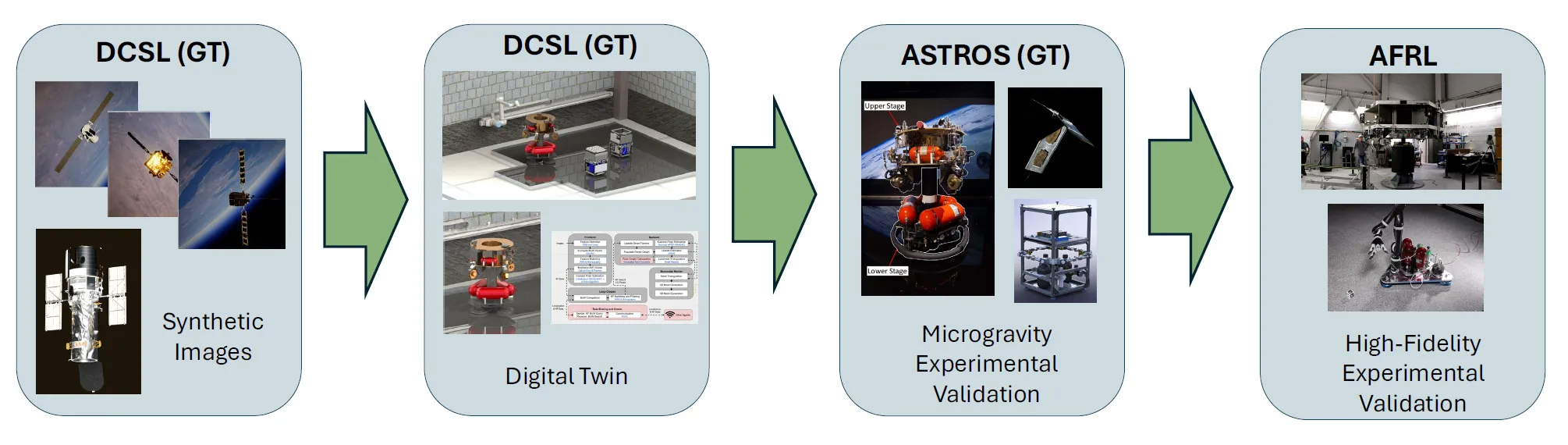 The evaluation plan, from synthetic imagery through the laboratory digital twin and the ASTROS air-bearing platform at Georgia Tech to hardware-in-the-loop validation at AFRL.
This project is a collaborative effort with Mert Pilanci at Stanford University and Meeko Oishi at the University of New Mexico, carried out in collaboration with the Space Vehicles Directorate of the Air Force Research Laboratory.
Sponsors
This project is sponsored by NSF.
Selected Publications and Presentations
None listed yet.