It has long been recognized that servicing and refueling spacecraft in orbit has the potential to revolutionize spacecraft operations by extending the useful lifetime of the spacecraft, by reducing launching and insurance cost, and by increasing operational flexibility and robustness. Most of the previous studies in the literature have assumed that a single spacecraft alone undertakes the task of refueling the whole constellation. That is, a single service spacecraft plays the role of the sole supplier of fuel. In this work we investigate peer-to-peer (P2P) refueling scenarios for satellite constellations with (potentially) a large number of satellites. In a P2P scenario, no single spacecraft is in charge of the complete refueling process. Instead, all satellites share the responsibility of refueling each other on an equal footing. A P2P refueling strategy is, by definition, a distributed method for replenishing a constellation of spacecraft with fuel/propellant. Consequently, it offers a great degree of robustness and protection against failures. For instance, with a P2P strategy a failure of a single spacecraft will have almost no impact on the refueling of the rest of the constellation. On the contrary, a failure of the service vehicle in a single-spacecraft scenario will result in the failure of the whole mission.
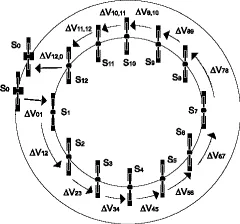
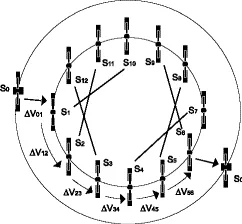 Single-spacecraft refueling strategy (left) and mixed refueling strategy (right).
A P2P scenario arises naturally as an essential component of a mixed refueling strategy. By mixed refueling strategy we mean a strategy which involves at least two stages. During the first stage a single spacecraft refuels only a certain fraction (perhaps half) of the satellites. During the second stage the satellites that received fuel during the first stage act as go-betweens, and distribute the fuel to the rest of the constellation in a P2P manner. That is, a P2P refueling strategy can be implemented as the final distribution phase of a single-vehicle refueling strategy. One of the interesting results of our analysis shows that a mixed refueling strategy is more fuel-efficient than a single-spacecraft strategy, especially for a large number of satellites in the constellation and for short refueling periods. As a matter of fact, cases exist for which the single-spacecraft scenario is infeasible (due to the time constraint), while a mixed refueling strategy is still possible.
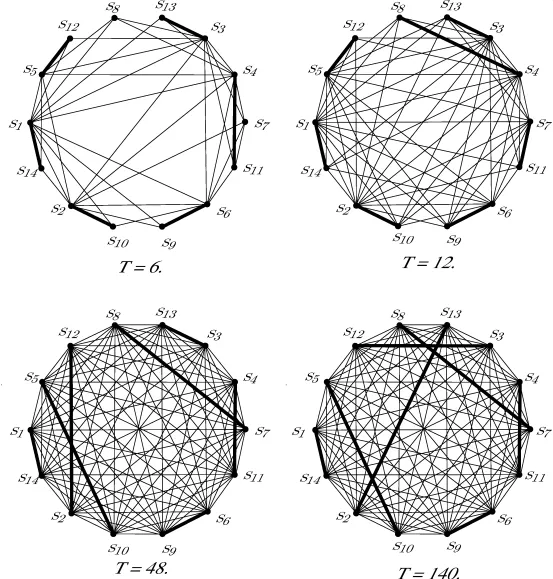
The mathematical tools used to solve the coordinated refueling problem is graph theory and operational theoretic algorithms (matching between bi-partite graphs, auction algorithms). The auction algorithms, in particular, have the advantage that a matching between fuel deficient and fuel sufficient satellites in the constellation can be found in a distributed or asynchronous manner, which is desirable for a large number of satellites.
A key ingredient in our approach is a new method for solving the multi-revolution Lambert’s problem. The classical Lambert’s problem computes the transfer orbit between to points in space for a given amount of time. Allowing several revolutions makes the problem more complicated and requires the calculation of 2*Nmax+1 possible solutions.
We have found a way to compute the transfer orbit, for given time and initial and final orbits, by checking only two out of the possible 2*Nmax+1 candidate solutions. The final outcome of this process is a quick calculation of the optimal (fuel-efficient) Delta-V as a function of the transfer time and the initial separation angle theta between the two satellites. This can be represented as a contour plot.
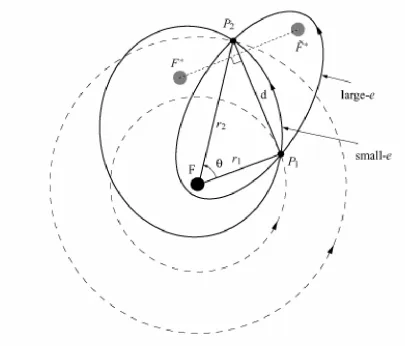
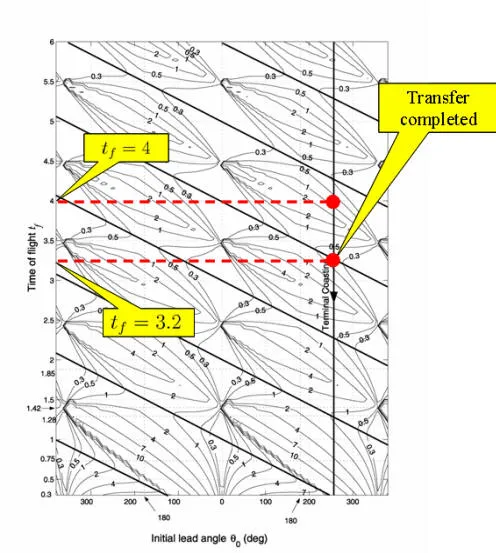 Lambert’s problem (left): two transfer orbits of differing eccentricity joining the same two points. Right: Δv contours against time of flight and initial lead angle, with two completed transfers marked.
Sponsors
This project is sponsored by AFOSR.
Selected Publications and Presentations
Salazar A. and Tsiotras, P., “An Auction Algorithm for Optimal Satellite Refueling,” Georgia Tech Space Systems Engineering Conference, Atlanta, GA, November 8-10, 2005, Paper No. GT-SSEC.F.5,.
Salazar A. and Tsiotras, P., “An Auction Algorithm for Allocating Fuel in Satellite Constellations Using Peer-to-Peer Refueling,” American Control Conference, Minneapolis, MN, June 14-16, 2006, pp. 4214-4219, (invited).
Dutta, A., and Tsiotras, P., “A Greedy Random Adaptive Search Procedure for Optimal Scheduling of P2P Satellite Refueling,” AAS Spaceflight Mechanics Meeting, Sedona, AZ, Jan. 28-Feb. 1, 2007, AAS Paper 2007-150.
Dutta, A., and Tsiotras, P., “A Network Flow Formulation for an Egalitarian P2P Satellite Refueling Strategy,” AAS Spaceflight Mechanics Meeting, Sedona, AZ, Jan. 28-Feb. 1, 2007, AAS Paper 2007-151.
Dutta, A., and Tsiotras. P., “Hohmann-Phasing Cooperative Rendezvous Maneuvers,” F. Landis Markley Astronautics Symposium, Chesapeake Bay, June 28-July 2, 2008, Paper AAS 08-297.
Dutta, A., and Tsiotras, P., “A Cooperative P2P Refueling Strategy for Circular Satellite Constellations,” AIAA Space Conference and Exhibit, San Diego, Sept. 9-11, 2008, AIAA Paper 2008-7643.
Dutta, A. and Tsiotras, P., “A Cooperative Egalitarian Peer-to-Peer Strategy for Refueling Satellites in Circular Constellations,” AAS/AIAA Space Flight Mechanics Meeting, Savannah, GA, Feb. 8-12, 2009, AAS Paper 2009-109.