This project developed and experimentally validated vision-based estimation and control algorithms for proximity operations with non-cooperative target satellites — targets for which no prior knowledge of shape, mass properties, or appearance is available, and which carry no fiducial markers to assist approach and docking. Tracking such a target means estimating its six-dimensional pose and its three-dimensional shape simultaneously, the problem known in ground robotics as SLAM (Simultaneous Localization and Mapping) and SfM (Structure from Motion).
Proximity operations enable routine servicing, inspection, and refueling of satellites, and are equally central to protecting friendly space assets or monitoring an adversary’s. The need is sharpest in geosynchronous orbit: at nearly 25,000 miles, objects in GEO are too small for detailed observation by optics or radar from the ground, so a small servicer flown in close proximity is the only practical way to assess a target’s structural health or to identify and categorize an unknown one.
Carrying SLAM and SfM into orbit required adapting them to conditions ground robots never face — harsh and rapidly changing illumination, the absence of background inertial feature points — and to the power and computational limits of spacecraft avionics.
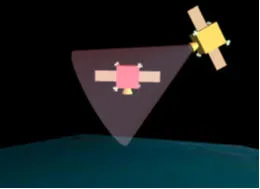
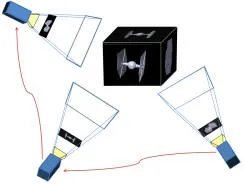
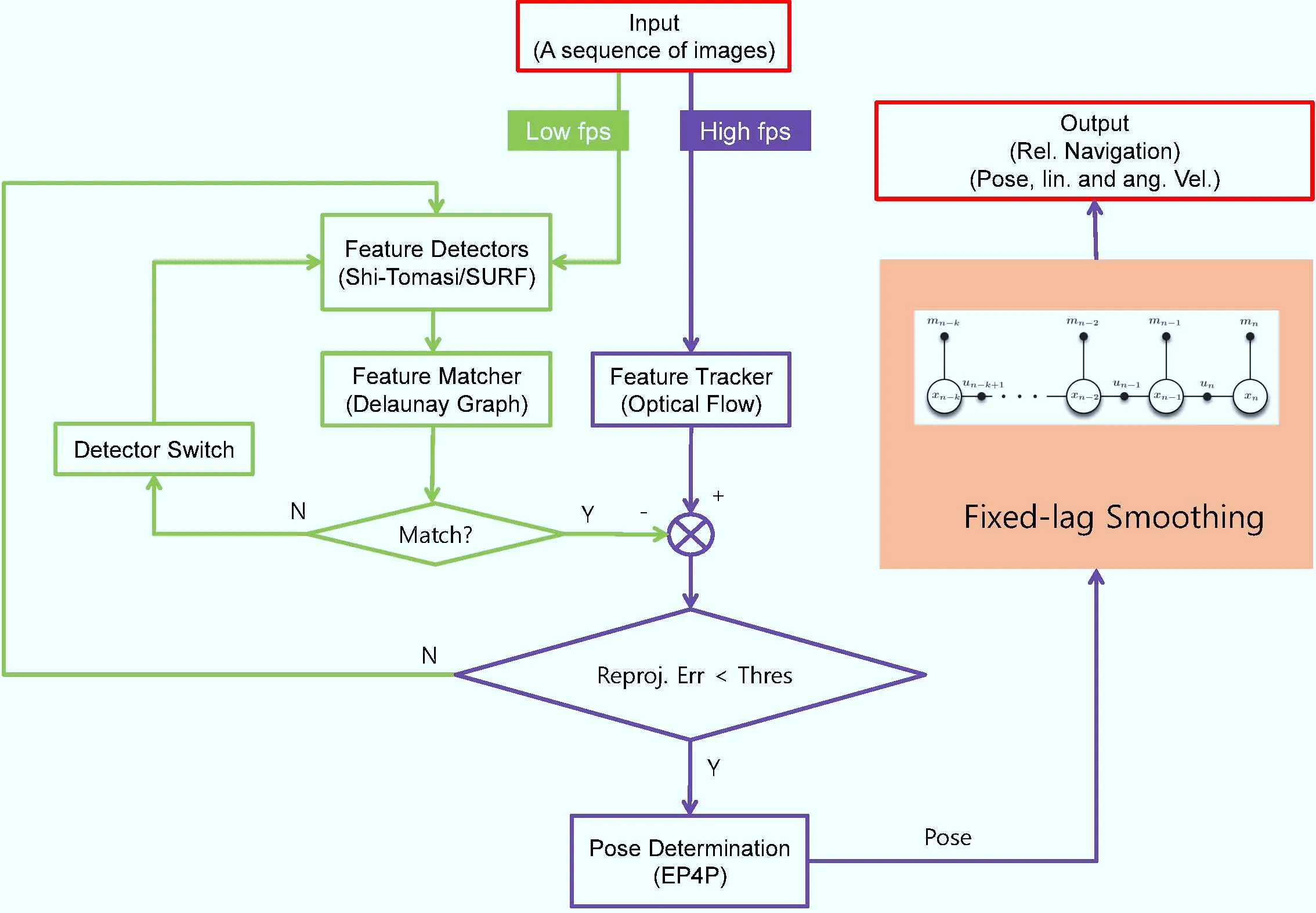
Feature Tracking. Two feature detectors were used, selected according to the imaged scale change along the distance to the target: the Shi-Tomasi corner detector, and the rotation- and scale-invariant SURF (Speeded Up Robust Features) blob detector. Target re-acquisition used point pattern matching based on a Delaunay triangulation, giving fault-tolerant automated relative navigation. For bundle adjustment, a fixed-lag smoothing SLAM algorithm over a probabilistic graph model produced optimized pose, linear velocity, and angular velocity estimates. The implementation was built on GTSAM, the factor-graph smoothing library developed at Georgia Tech by Frank Dellaert’s group, which exploits the sparsity of the resulting graph to deliver accuracy and real-time execution guarantees that filtering-based methods do not.
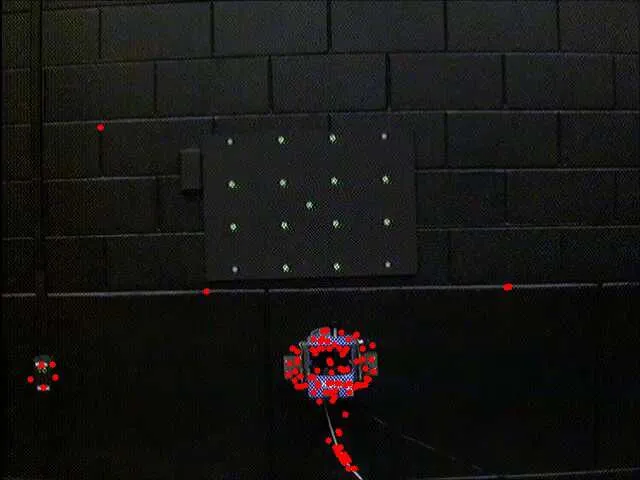
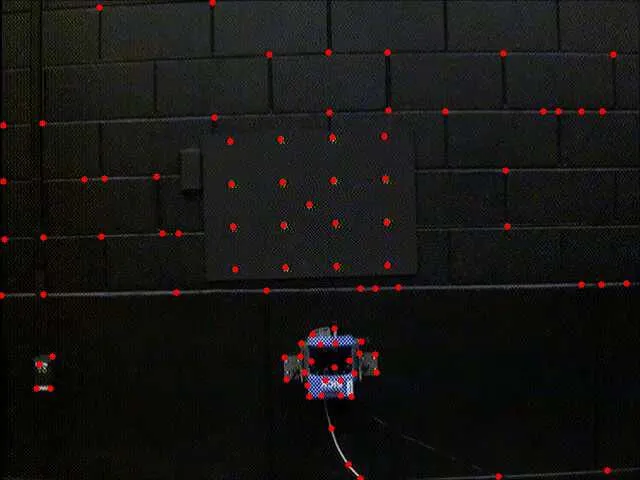
The processing chain from onboard video to pose estimate is shown below.
Dual Quaternions for Coordinated Relative Attitude and Position Navigation and Guidance. Control laws for tracking a target satellite’s attitude and position were developed using dual quaternions, an extension of classical quaternions that represents coupled rotation and translation in a single compact object. The representation follows Chasles’ theorem — that any rigid-body displacement is a rotation about a screw axis together with a translation along it — and among the alternatives for expressing that screw motion, dual quaternions are the most efficient in both storage and operation count. They also account for the natural coupling between rotational and translational motion rather than treating the two separately. Building on this formalism, the project produced velocity-free controllers, which require no angular or linear velocity measurements, and adaptive controllers, which require no knowledge of the satellite’s mass or inertia.
Experimental results from the dual-quaternion controller and the dual-quaternion multiplicative extended Kalman filter (DQ-MEKF) are shown below.
Experimental Validation
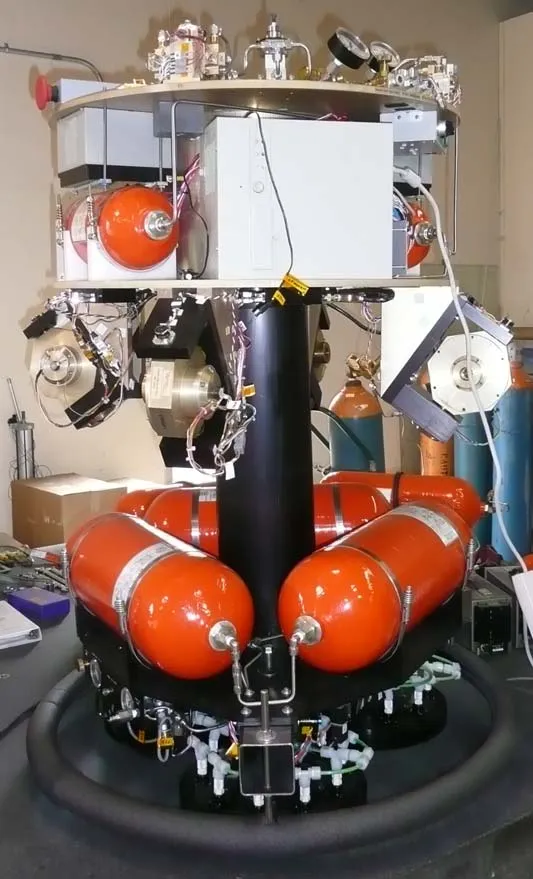
Validation used the 5-DOF Autonomous Spacecraft Testing of Robotic Operations in Space (ASTROS) facility at the Georgia Tech School of Aerospace Engineering, which supports experiments in vision-based autonomous rendezvous and docking for spacecraft servicing and refueling. The platform rests on a hemispherical air bearing providing three rotational degrees of freedom — ±30° about the horizontal x and y axes, and ±360° about the vertical z axis — actuated by four Variable Speed Control Moment Gyros (VSCMGs) and eight dry-nitrogen thrusters. Its sensor suite comprises a three-axis rate gyro, a two-axis sun sensor, and a three-axis magnetometer. A linear air bearing adds translational motion, floating the whole platform on a thin cushion of compressed air.
Sponsors
This project was supported by AFRL.
Selected Publications and Presentations
Tsiotras, P., “ASTROS: A 5DOF Experimental Facility for Research in Space Proximity Operations,” 37th AAS Guidance and Control Conference, Breckenridge, CO, Jan. 31-Feb. 5, 2014, AAS Paper 14-114.
Valverde, A., Filipe, N., Kontitsis, M. and Tsiotras, P., “Experimental Validation of an Inertia-Free Controller and a Multiplicative EKF for Pose Tracking and Estimation Based on Dual Quaternions,” 38th AAS Guidance and Control Conference, Breckenridge, CO, Jan. 30-Feb. 4, 2014, AAS Paper 2015-017.