Bounded rational refers to the process of decision-making when the main goal is not necessarily an optimal decision, but rather one that meets the intelligent agent’s aspiration level. According to this “satisficing”(or bounded rationality) paradigm, human beings (as well as other mammals) tend to weight the benefits of reaching the “best” or “most informed” decision, versus the pitfalls associated with the time, energy and effort needed to collect all the information to reach that decision. In this research we propose bounded rationality perception and action models inspired by the perception and action mechanisms of the human brain. The main tenet of the proposed research builds on our belief that the current paradigm of perception in robotic agents is not relevant for most real-life problems, because of its inability to extract actionable information from raw sensory inputs. By extracting and operating on the actionable information, we will be able to develop decision-making models and algorithms for (expert) human-like perception and decision-making for autonomous systems performing demanding tasks at much shorter time scales and with fewer computational resources that what is currently available. To achieve this objective, we will draw inspiration from the cognitive models and the associated perception mechanisms of the human brain. Specifically, and guided by the perceptual architectures of the human visual cortex, we plan to develop probabilistic inference models that leverage attention-focused principles by operating on actionable data in a timely manner. Attention-driven mechanisms can bias decision-making and thus impose a prioritization of (re)action options, each of progressively higher fidelity. The incorporation of new information during this process can be dealt with by imposing (or taking advantage of) the natural spatio-temporal multi-scale structure of the collected data. We will couple these perceptual inputs with prior segmented dynamic motions (action primitives), similarly to the observed manner by which expert humans plan/react while executing challenging tasks. These primitives can be learned off-line and fine-tuned on-line and—when coupled with suitable perceptual inputs and the associated sensory inputs—can implement a human-like pre-emptive perception mechanism for reacting very quickly to external stimuli.
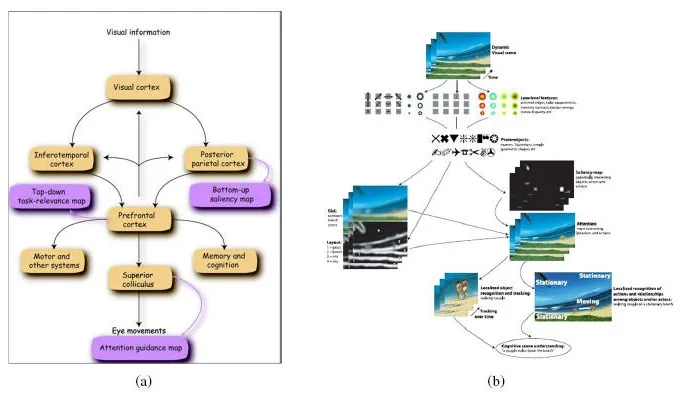 (a) The main informational pathways of the human visual cortex: information proceeds along two separate streams, the occipital-temporal “what” stream and the occipito-parietal “where/how” stream, through both feedforward and feedback mechanisms. (b) Recent work in computational neuroscience mimics this hierarchy to blend bottom-up, stimulus-driven and top-down, goal-driven perceptual cues.
Our initial attempt to duplicate this hierarchical computational architecture of the brain was on a joint perception/action multi-resolution problem in arbitrary dimensions using trees. Contrary to similar prior approaches in this area, we imposed spatial coherence on the node occupancy values using a conditional random field that assigns the node value based not only on the measurement but also on the values of the neighboring cells (supervoxels). We improved on the initial algorithm in several aspects. First, we developed a new method to compute graph neighbors, thus reducing the complexity of each iteration from to . We can also delay expensive intermediate computations until we know that new information will be required, hence saving time by not operating on information that is never used during the search. Finally, we devised a way to remove the very expensive calculation of a full multi-scale map via the use of sampling. In a parallel line of research, we investigated sampling-based methods for path-planning. Sampling-based methods have the advantage that they are highly parallelizable and can be used in a “natural” multi-resolution fashion: the constructed graph is refined with each iteration, as more data is sampled. The graph construction can terminate at any point, depending on the available memory and time. We have shown that, combined with asynchronous programming ideas, these graphs result in highly efficient satisficing/anytime solutions for path-planning problems. Finally, we have used information-theoretic ideas to account for the computational costs incurred during the search for optimal actions in a sequential decision-making problem. The traditional (MDP) framework ignores computational limitations while searching for optimal policies, essentially assuming that the acting agent is perfectly rational and aims for exact optimality. Using the free energy, a variational principle is introduced that accounts not only for the value of a policy alone, but also considers the cost of finding this optimal policy. The solution of the variational equations arising from this formulation can be obtained using familiar Bellman-like value iterations from dynamic programming (DP) and the Blahut-Arimoto (BA) algorithm from rate distortion theory. We demonstrated the utility of the approach for generating hierarchies of state abstractions that can be used to best exploit the available computational resources in a “satisficing” manner.
This project is in collaboration with S. Soatto and S. Schaal, and L. Itti. Please visit their websites for additional publications.
Sponsors
This project is supported by ONR.