Achieving crash/accident avoidance or active safety for passenger vehicles has been refocused at NHTSA and the automotive industry. These active safety systems are electronically controlled, and include driver-assistance software and hardware, to prevent the vehicle from getting into trouble (e.g., skidding, tumbling, crashing, etc). The objective of this research project is to build on the existing state of knowledge from the aerospace control community (that has dealt with “fly-by-wire”, “directional control” and “envelope protection” problems since its inception), as well as on our own previous experience in the analysis of the dynamics and the optimal control of wheeled vehicles (especially the characterization of tire friction forces, and vehicle attitude and directional control) in order to develop new control methodologies for achieving vehicle performance that mimics the way expert humans drivers react during emergencies.
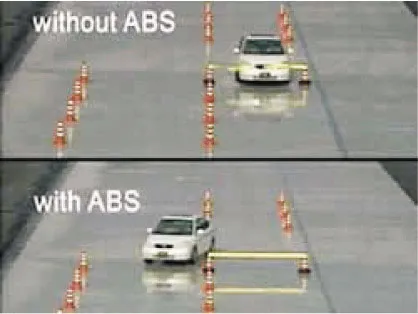
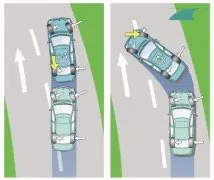 The ABS (left) prohibits wheel lockup during braking, allowing the driver to maintain directional control of the vehicle. The ESP system (right) is a yaw control system: it applies independent braking to the four wheels in order to generate the required moments.
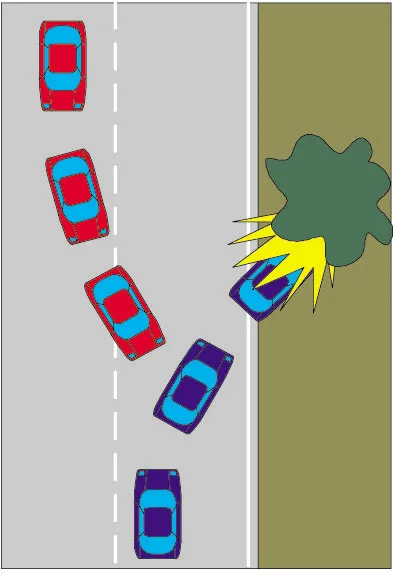
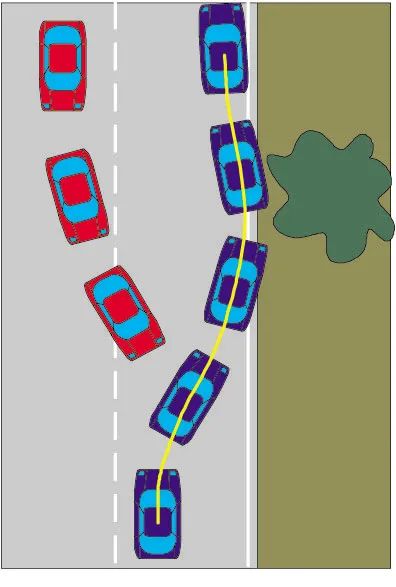 The increase in single-vehicle accidents involving ABS vehicles may be due to the wrong response by the driver. Since ABS maintains directional control even during hard braking, sudden or extreme steering by the driver may result in the vehicle driving off the road (left). A properly designed active control safety system will intervene, momentarily take over control of the vehicle, and correct the driver’s command so as to maintain or recover control even under the most severe maneuvering (right).
Car accidents result in more than 40,000 deaths and 2,780,000 injuries each year in the US alone and many more worldwide. Car accidents are, in fact, the leading cause of mortal injuries globally, accounting for almost 23% of the total. They are the leading cause of death between ages 3-33. The current state-of-the-art of passive and active automotive safety systems is not adequate to reverse these statistics. A more comprehensive approach is needed. Supported by the advent of MEMS sensor technology, the emergence of embedded control software, and the rapid progress in computer and DSP technology, several automotive manufacturers have responded with a more holistic view of accident prevention that incorporates situational awareness and new control systems with learning and decision capabilities. Meeting these objectives will require some radical changes in the way current active safety systems operate and interact with the human driver.
A second strand of this work therefore proposes a new way of looking at the problem of crash avoidance: the study, analysis, capture and encapsulation of expert driver knowledge within a rigorous mathematical framework, and the incorporation of that knowledge inside the control architecture. These on-demand auto-pilots take advantage of the situational sensing capabilities of future vehicles to detect impending accidents. They determine whether normal driver reaction is adequate to avoid a crash. If not, they intervene and, if necessary, override the driver’s commands by initiating steering, braking or accelerating commands to drive away from an accident or — whenever this is not possible — mitigate the effects of the crash.
What we propose here is not unlike what the aerospace industry has done a long time ago. Indeed, the first control systems introduced in airplanes were relatively simple stability augmentation systems (SAS), whose main objective was to increase the stability of certain modes of the airplane (e.g., modify the damping and natural frequency of the short-period mode, increase the damping of the dutch-roll mode, etc). With the advent of fast and reliable computers, and the development of more sophisticated control algorithms, the airplane manufacturers moved quickly to more comprehensive flight management systems (FMS) which use actively controlled modules, known as “fly-by-wire” (FBW) systems.
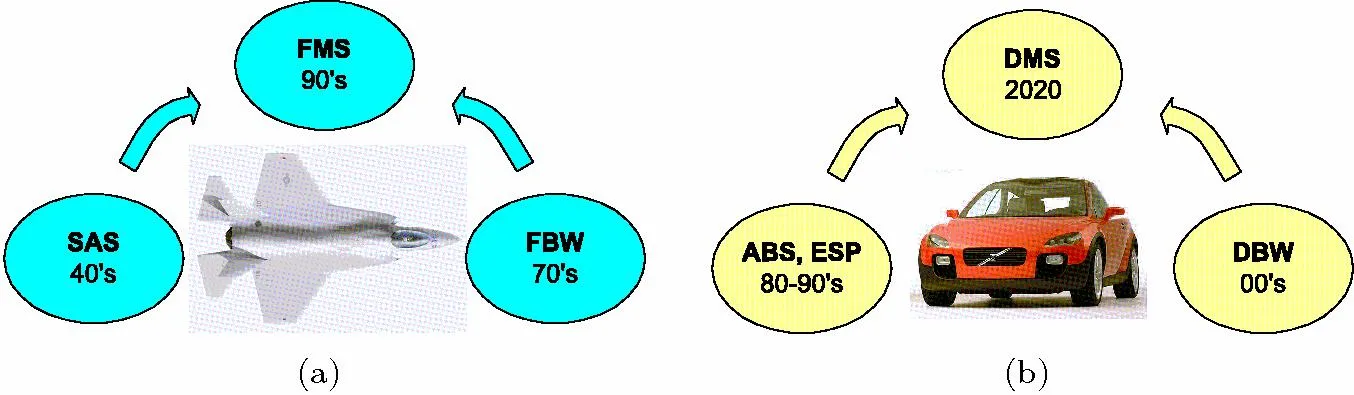 The same progression in both industries: separate stability and actuation technologies converging on an integrated management system.
FBW systems, originally developed for high-performance military fighter aircraft, are truly feedback systems: the on-board computers intercept the pilot’s commands, interpret them accordingly, and decide the actual actuator input to apply at each instant of time. With a FBW system there is no direct mechanical connection between the pilot and the actuators. It is the job of the FBW/FMS system to alleviate the pilot from excessive workload and make sure that the airplane flies within its designed flight envelope (“envelope protection”). The success of FBW systems has made them a standard component in all current military aircraft as well as in the new generation of civilian aircraft.
Sponsors
Support for this project is provided by NSF, in collaboration with Ford
Movies
A 90 degree skidding maneuver.
A trail-braking maneuver, in three dimensions.
A pendulum turn, in three dimensions.
A T-bone mitigation maneuver.
Experimental results were also obtained on the AutoRally platform.
Selected Publications and Presentations
Velenis, E., Katzourakis, D., Frazolli, E., Tsiotras, P. and Happee, R., “Stabilization of Steady-State Drifting for a RWD Vehicle,” 10th International Symposium on Advanced Vehicle Control (AVEC), Loughborough, UK, August 22- 26, 2010.
Velenis, E., Frazzoli, E., and Tsiotras P., “Steady-State Cornering Equilibria and Stabilization for a Vehicle During Extreme Operating Conditions,” International Journal of Vehicle Autonomous Systems, Special Issue on Autonomous and Semi-Autonomous Control for Safe Driving of Ground Vehicles, Vol.8, Nos. 2-4, pp. 217-241, 2010.